

Performance
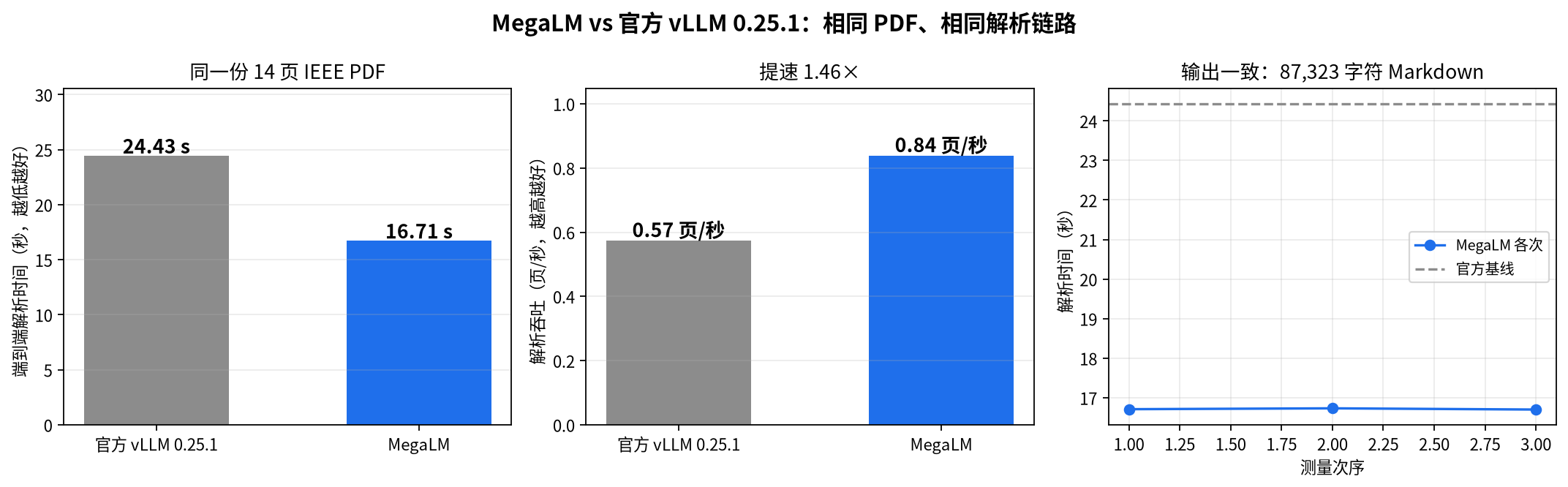
We evaluate the complete document parsing pipeline on a 14-page IEEE paper, measuring the time from PDF submission to the final Markdown output.
MegaLM completes three measured runs in 16.71, 16.73, and 16.70 seconds, with a spread of just 30 ms. The resulting Markdown achieves 99.93% text similarity across the two backends, with matching body text, tables, and paragraph order.
| Metric | vLLM 0.25.1 | MegaLM |
|---|---|---|
| End-to-end latency | 24.43 s | 16.71 s |
| Parsing throughput | 0.573 pages/s | 0.838 pages/s |
| Processed pages | 14 | 14 |
| Markdown characters | 87,330 | 87,323 |
OXR Integration
OXR's page-level reading-order requests contain approximately 10K context tokens, making concurrent document parsing a demanding workload for request scheduling and KV cache management.
This integration improves generation configuration compatibility and introduces KV cache-aware request admission, enabling MegaLM to serve concurrent long-context requests within a constrained GPU memory budget, without changes to the OXR application pipeline.
Benchmark Setup
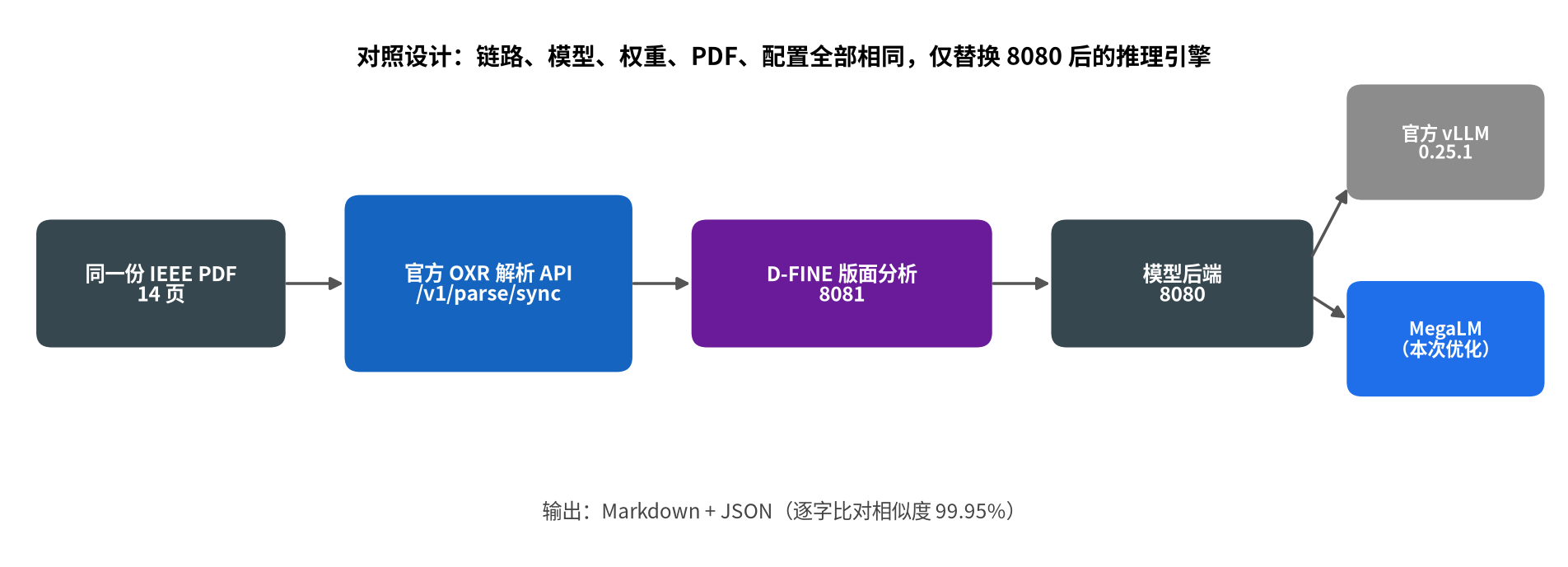
Both backends use the same IEEE PDF, OXR API, D-FINE layout analysis service, and BF16 model weights. Serving configurations are identical: 16,384-token maximum context length, 0.70 GPU memory utilization, and 16 maximum concurrent sequences. Results report the median of three measured runs after one warmup per backend.
These results apply to the evaluated document and deployment configuration. Output similarity is not a measure of OCR accuracy.
This integration demonstrates MegaLM's capabilities beyond isolated model benchmarks, extending to long-context inference and end-to-end document understanding. We welcome the community to evaluate MegaLM on more real-world workloads.