

About Inkling 2 Mini
Released by Thinking Machines Lab on November 20, 2026, Inkling 2 Mini is an open-weight multimodal model designed for coding, agentic workflows, and general-purpose reasoning.
Its architecture combines recurrent layer execution with sparse mixture-of-experts:
The looped architecture increases computational depth without a proportional increase in model weights, introducing distinct requirements for model execution, quantized kernels, and cache management.
- 26.4B total parameters and 3.4B active parameters.
- 24 Transformer layers with three passes through the middle 12 layers, yielding 48 layer applications per token.
- 128 experts with top-8 routing.
- Hybrid local and global attention.
- A declared context window of up to 1M tokens.
Performance
We evaluate MegaLM on a single RTX 3090 across concurrent chat serving, long-context agent replay, and synthetic throughput scaling.
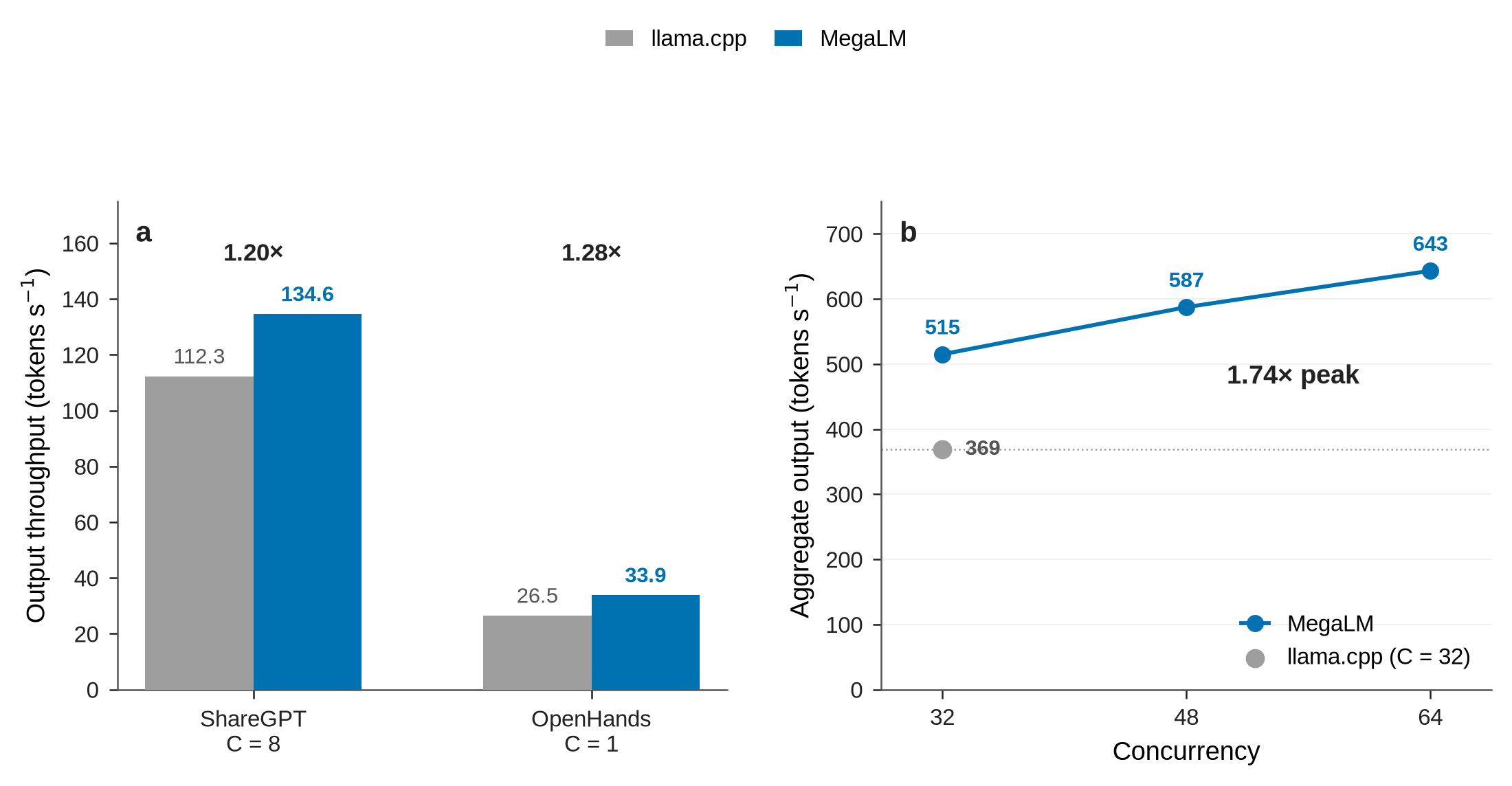
All throughput figures are aggregate output tokens/s. Measured peaks occur at C32 for llama.cpp and C64 for MegaLM.
At matched concurrency of 32, MegaLM delivers 39.5% higher output throughput. Scaling further to 64 concurrent requests increases throughput to 643.3 tokens/s, with continued gains across the measured range.
| Workload | llama.cpp | MegaLM | Speedup |
|---|---|---|---|
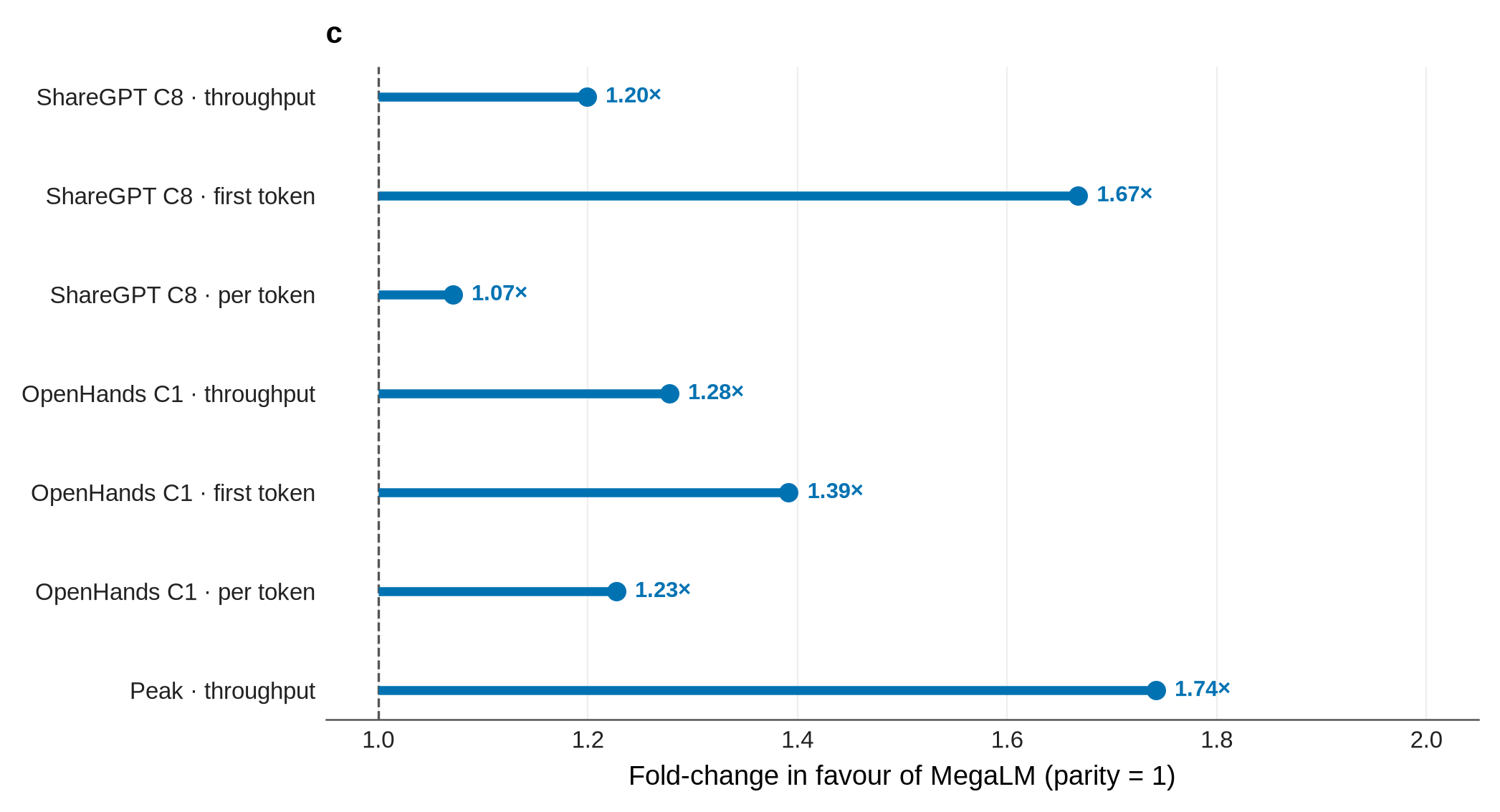
| ShareGPT · C8 | 112.3 | 134.6 | 1.20× |
| OpenHands · C1 | 26.5 | 33.9 | 1.28× |
| Synthetic · C32 | 369.3 | 515.0 | 1.39× |
| Peak throughput | 369.3 | 643.3 | 1.74× |
Latency
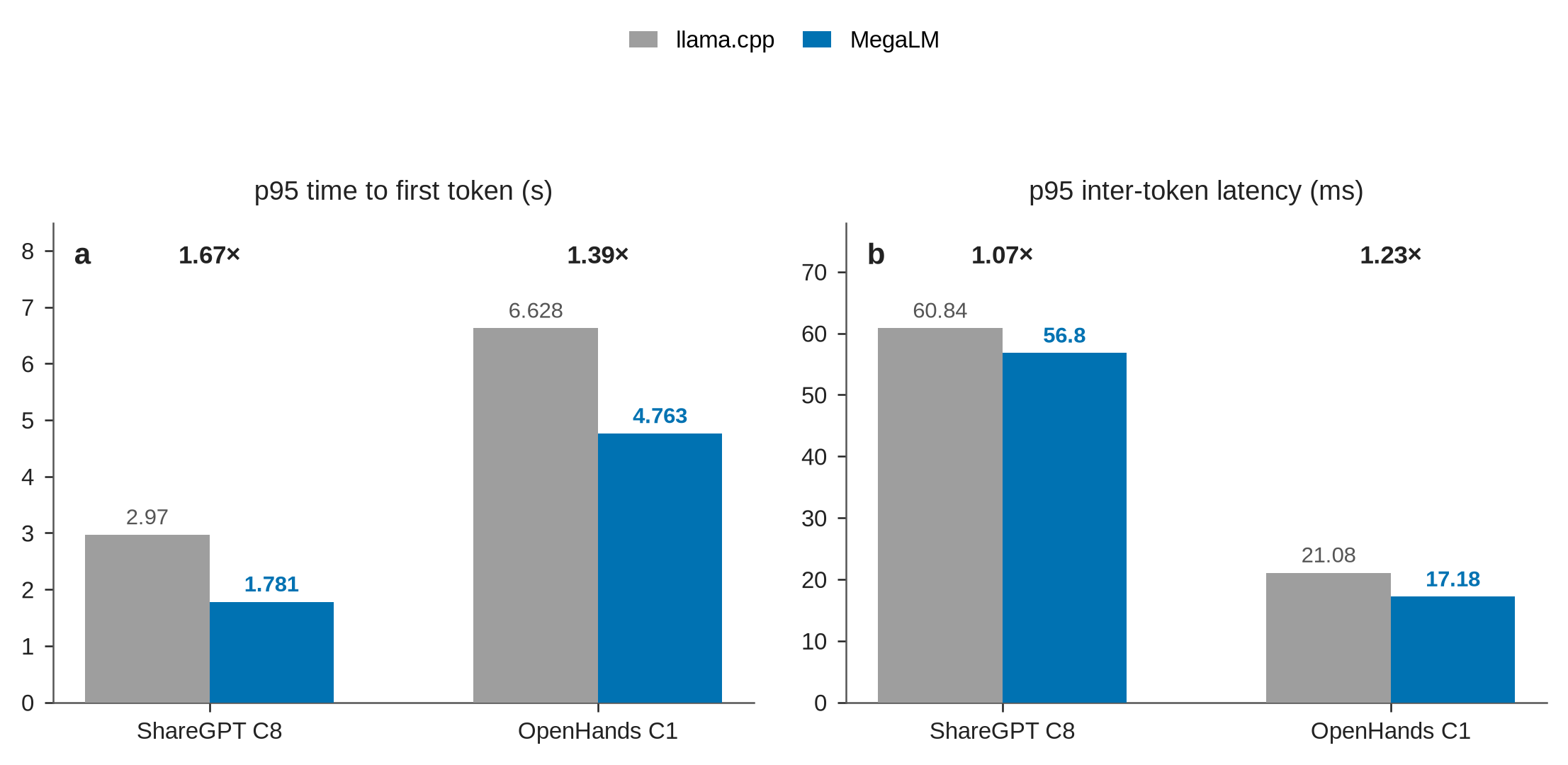
MegaLM improves both throughput and request latency on the two representative workloads.
On the nine-turn OpenHands replay, where input lengths grow from 7.9K to 11.4K tokens, MegaLM reduces p95 time to first token from 6.63 seconds to 4.76 seconds.
| p95 Metric | ShareGPT | OpenHands |
|---|---|---|
| Time to First Token | −40.0% | −28.1% |
| Time per Output Token | −6.6% | −18.5% |
| End-to-End Latency | −15.0% | −20.3% |
Native Support in MegaLM
Inkling 2 Mini runs on the native TensorPlay compute stack, without Transformers execution in the inference hot path.
The integration includes:
Together, these capabilities enable efficient Inkling 2 Mini serving on consumer-grade GPUs.
- Native Looped Transformer Execution. Recurrent layer execution with hybrid local and global attention.
- Quantized MoE. Optimized execution of group-128 INT4 weights with BF16 computation.
- Paged Attention & Prefix Caching. Paged KV management and reuse of shared prompt prefixes.
- Adaptive KV Cache. Automatic cache sizing based on the available device memory budget.
Getting Started
Once MegaLM is installed, launch an OpenAI-compatible inference server:
For installation instructions and deployment options, visit the MegaLM repository.
Benchmark Notes. All measurements use an exclusive RTX 3090 (24 GB), vllm bench serve, streaming /v1/completions, and temperature 0. ShareGPT uses 32 requests; OpenHands uses a nine-turn public trajectory replay. Synthetic benchmarks use repeated 484-token prompts and 128 output tokens, with one warmup and the median of three measured runs. MegaLM uses prefix caching and group-128 INT4 execution, while llama.cpp uses mixed NVFP4/Q8_0 GGUF weights. Results compare practical serving configurations rather than quantization-matched engine implementations. Streaming p95 ITL is comparable between the two engines. These benchmarks cover text generation only; visual inference and million-token context capacity are not evaluated.
megalm-serve thinkingmachines/Inkling-2-Mini \
    --served-model-name inkling-2-mini \
    --host 127.0.0.1 \
    --port 8000